Friday, October 8, 2010

IT'S KIND OF A FUNNY STORY: The Film Babble Blog Review

IT'S KIND OF A FUNNY STORY (Dirs. Anna Boden & Ryan Fleck, 2010)

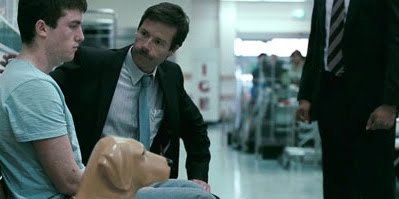
After a couple of extremely promising dramas (HALF NELSON and SUGAR), the writing/directing duo of Boden and Fleck now give us the comic story of a suicidal teenager (Keir Gilchrist) who checks into an adult psychiatric ward.

This is because the juvenile ward is undergoing renovations, but really so he can bond with comedian Zach Galifianakis as a friendly patient with family problems.

Gilchrist hates his situation and wants out immediately but has to stay for a five day evaluation. It helps that he’s attracted to the 16 year old emotionally disturbed Emma Roberts.

Gilchrist and Roberts fall into a round-the-clock flirtation, meeting each other for art classes in which Gilchrist’s confidence is boasted when he impresses everyone with his art which the film animates.

The confused kid also impresses with his musical ability via one of the most embarrassing and unnecessary musical numbers of recent memory: a rock video sequence set to the Queen/David Bowie song “Under Pressure” complete with glam costuming, strobe lighting, and backup singer nurses that aren’t in the rest of the movie.

That’s the problem with this film – all the gimmickry. What could have been an earnest depiction of dealing with depression is yet another Wes Anderson style retread. It has all the clichés you’d expect such as a virgin lead fumbling through the advice of quirky characters that are supposed to be seriously messed up but actually are just slightly screwy.

Galifianakis is one of the best standups out there (check out “Live at the Purple Onion” if you haven’t) and also a strong supporting actor (see HBO’s Bored To Death), but this is a lazily written role. Galifianakis has a few effective moments, such as acting out a tantrum in a key scene, but try is he might this weak material never elevates above “After School Special” territory.

It’s like making a sitcom out of ONE FLEW OVER THE CUCKOO'S NEXT or GIRL INTERRUPTED. The result is to trivialize mental illness for the sake of an anything-for-a-laugh mentality.

This is apparent in the casting. Every other role is a recognizable actor or actress that do little but walk on for the purpose of familiarity. For example there’s Aasif Mandvi from The Daily Show as a doctor, Gilchrist’s parents are played by comedian Jim Gaffigan and Gilmore Girls mom Lauren Graham, Jeremy Davies (Lost) is in a nothing role as a hospital attendant, and Violas Davis (DOUBT) as a stern but, of course, fair doctor.

IT'S KIND OF A FUNNY STORY is too cutesy and clunky to hold much water. When Gilchrist and Roberts run laughing down the corridors of the hospital with a pop song (courtesy of the Broken Social Scene) pumping on the soundtrack it made my heart sink.

The notion that real despair is curable by way of a puppy love fling and bumper sticker wisdom is anything but uplifting. In fact it’s more depressing than anything anyone faces in this empty and immensely forgettable film.

More later...

Wednesday, October 6, 2010

HEARTBREAKER: The Film Babble Blog Review

HEARTBREAKER (Dir. Pascal Chaumeil, 2010)

“My name is Alex Lippi – I break up couples for a living.”

So says the dapper Romain Duris at the beginning of this French high concept rom com.
The high concept being that Duris, his sister (Julie Ferrier), and her husband (François Damiens) run a business designed to break up relationships.

We are given a tour of their methods which involve monitoring their targets through surveillance with Duris working his charms on them in a montage in which we see the master manipulator using the same lines and pushing the right buttons to make women of all kinds swoon.

In documentary fashion, his assistants explain that it never goes further than a kiss. Duris leaves the women, he describes as “unhappy without knowing it”, and they thank him for “opening their eyes.”

After that juicy set-up, Duris and Co. are hired by a wealthy powerful businessman (Jacques Franz) to break up the wedding of his daughter (Vanessa Paradis) to her affluent fiancé (Andrew Lincoln).

The catch is that the technically savvy yet still stumbling team only have 10 days to do so before the couple’s wedding.

Most of the film’s action takes place in a hotel in Monocco with Duris acting as bodyguard to Paradis. She dislikes him at first – which is a obligatory element of rom coms of course – but over time they develop the also obligatory will-they/won’t they chemistry.

Duris works on his “Dirty Dancing” moves (because that’s her favorite movie), has Wham! ready to play from a fake radio signal on command (because that’s her favorite music), and he eats Roquefort for breakfast (because that’s her favorite…oh, you get the idea).

With a soundtrack full of sprightly pop songs (most English language actually) the film has a hip snazzy pulse to it, but the predictable conventions make the whole package go from cute to cringe worthy in the second half.

There are enough chuckles if not full out laughs and the spirit is likable, but there is too much hit-somebody-on-the-head slapstick and the climatic rush to stop the wedding finale is such a cliché at this point that it reeks of narrative laziness.

The cast is not without charm though the beautiful Paradis seems far from committed to her character and her scenes with Duris do not have the required heat needed to tug on the audience’s heartstrings.

Like Duris does, the fair and only slightly funny HEARTBREAKER overestimates its charm throughout. It’s a piece of cinematic cheese that I’m sure some audiences will eat up, but I believe many moviegoers will find that such a tasty premise deserved way better.

More later...

Monday, October 4, 2010

Blu Ray/DVD Review: (UNTITLED)

UNTITLED (Dir. Jonathan Parker, 2009)

Watching one of my favorite movies recently - Richard Linklater's DAZED AND CONFUSED (1993) - I remembered thinking back in the day that amongst its cast of attractive newcomers (which included Matthew McConaughey and Parker Posey) that the acerbic Adam Goldberg was going to break big.

I was way wrong about that, but Goldberg has honed his sardonic persona nicely over the course of a respectable career in indie films as well as many roles on television.

As the pretentious pianist Adrian Jacobs in Jonathan Parker's film (UNTITLED), Goldberg shows like in Julie Delphy's 2 DAYS IN PARIS that he's more than capable of carrying a movie and giving it a discernable viewpoint.

The viewpoint here is about the world of modern art in New York City. Goldberg performs with a small group of musicians his particular brand of "sound art". It is cacophony made out of clanging metal buckets, violently banging the piano keys, and intermittent primal screaming. The group's "music" makes small audiences even smaller when performed live.

Goldberg works his worry lines harder than usual while arguing: “Is the market place the measure of value in our culture? That would mean the death of all thought!”

Goldberg's brother (Eion Bailey) is a painter who has had success selling his work to hotel chains through a gallery run by Marley Shelton. Shelton is the only one who seems to appreciate Goldberg's compositions and arranges for them to play at one of her exhibitions.

So you just know that Shelton and Goldberg are going to get together and Bailey is both going to feel left out of Shelton’s heart and her gallery.

There is more going on than that in this film, but it’s thwarted by misguided characters such as Zak Orth as a computer millionaire art collector who only exists in the film to be ridiculed. Likewise a minimalist "thumbtack" artist (Ptolemy Slocum) who Bailey resents because he gets a show at Shelton's gallery and is treated like a genius.

Much more effective is the brash Vinnie Jones as a over-hyped visual artist who chews and spits out all the scenery around him. There is also a subtle turns by Lucy Punch billed only as "The Clarinet".

Still there is a lot of worth to the discussion about modern art and commerciality this film provokes. There are considerable comparisons to be made with the work of Terry Zwigoff (Think GHOST WORLD not the contrived ART SCHOOL CONFIDENTIAL).

Another rewrite could've sharpened its attack, but (UNTITLED) has enough bite in it to be recommended. Goldberg may not be sneering his way to the bank, but with fine vehicles like this he's definitely building a wealth of indie cred.

More later...

Friday, October 1, 2010

THE SOCIAL NETWORK: The Film Babble Blog Review

THE SOCIAL NETWORK

(Dir. David Fincher, 2010)

This is the film that asks - is Facebook founder Mark Zuckerberg a computer nerd visionary or just an arrogant a--hole that ripped off his friends?

A bit of both appears to be the answer - but THE SOCIAL NETWORK, courtesy of Aaron Sorkn’s screenplay as realized by David Fincher, is far from a smear job on the world’s youngest billionaire.

Jesse Eisenberg, at his most coldly focused, plays Zuckerberg who we meet in a darkly lit Harvard college tavern in 2003 having an intense and intimidating conversation with his girlfriend (Rooney Mara).

It’s a back and forth that runs rings around your head, so much so that Mara takes the opportunity to break up with Eisenberg. He sulks back to his dorm room and blogs that she’s a bitch and that he needs a new project to get his mind off of her.

Drinking beer after beer, Eisenberg throws out errant ideas to his best friend (Andrew Garfield) before he settles on creating a site called “Facemash” – a Hot Or Not-like site featuring pictures he hacked from campus computer databases.

Eisenberg finds that in addition to making his fellow female students very angry, it gets him noticed.

He’s approached by a couple of preppy crew rowing twin brothers (Josh Pence and Arnie Hammer) and their business partner (Max Minghella ) who want him to help them build a new social networking site called HarvardConnection.

“I’m in.” says Eisenberg and the film cuts to his deposition 3 years later where under oath he states that he doesn’t recall saying that.

You see, he’s being sued by the brothers for intellectual property theft in Federal court at the same time he’s being sued by Garfield over ownership of Facebook.

We bounce between flashbacks and testimony exchanges that detail Eisenberg devising the famous Facebook format while dodging email requests from the brothers.

When the site goes public Eisenberg and Garfield attract many followers, groupies and the attention of Napster founder Sean Parker (Justin Timberlake).

Timberlake seduces Eisenberg with his schmoozy charm, but not Garfield. Ties get even more tangled when Eisenberg rents a house in Silicon Valley which appears to be a nonstop party central despite the “wired in” employees working 24/7.

It’s easy to get caught up in the flow of this film. Sorkin’s dialogue is sharp, Fincher’s craft is on the scale of his best work (that includes FIGHT CLUB, SE7EN, and ZODIAC), and cinematographer Jeff Cronenweth’s swift camerawork frames it all with a minimum of flashy tricks.

The cast is pitch perfect. It’s Eisenberg’s best work to date, Garfield’s worrywart tone clashes correctly, and Timberlake predictably steals every scene he’s in.

Also Rashida Jones ("Parks And Recreation"), Bryan Barter, and the convincing brother duo of Pence/Hammer all chime in with sublime supporting roles.

There’s plenty on the internet about what’s accurate and what isn’t in this film, but the movie on its own is a storytelling gem.

You can see the point of view of the allegedly wronged parties and feel sympathy for the character of Zuckerberg even as he works overtime to hide his emotions.

Fincher, Sorkin and Co. obviously want us to see the irony in an anti-social guy who screws over the few friends he has in order to build one of the biggest and most profitable social internet websites in history.

A piece of supreme entertainment, THE SOCIAL NETWORK does indeed accomplish that task with relish. The only thing it’s missing is a big “Like” button for me to click at the end.

More later...

Tuesday, September 28, 2010

ANIMAL KINGDOM: The Film Babble Blog Review

ANIMAL KINGDOM (Dir. David Michôd, 2010)

At the center of this Australian crime drama is what seems at first to be a very unlikely protagonist.

James Frecheville portrays a Melbourne based teenager with dead eyes and bad posture who we meet as he awaits medics to tend to the body of his dead mother – a victim of a heroin overdose.

Frecheville is less interested in his mother’s death than he is a game show on television. He calls his grandmother (Jacki Weaver) in hopes of having a place to stay.

Weaver welcomes Frecheville into her home which also houses her 3 sons – Ben Mendelsohn, Sullivan Stapleton, and Luke Ford.

The brothers, along with their friend Joel Edgerton, are armed robbers and drug dealers. The police stake out their one floor shabby home around the clock.

Mendelsohn is the most menacing of the family – the second he appears on screen entering from the darkness, one knows that he will be the source of deadly discomfort later in the film.

As retaliation for the killing of one of their family – the brothers ambush and murder 2 police officers which bring on the investigation by Melbourne's Armed Robbery Squad led by Guy Pearce as a mustached detective without a corrupt bone in his body.

Frecheville has only one bright spot – his girlfriend Laura Wheelwright. When Mendelsohn eyes her though, we get another strong sense of dark foreshadowing.

Director Michôd brings out piercing performances from his cast. Frecheville proves himself worthy as a disaffected kid on the verge of manhood having to get a hold of his life’s direction in the face of the brutality of men like Mendelsohn.

Pearce, as the only “name” in the movie, has a few particularly affecting moments – especially in a monologue that explains the film’s title.

As the family matriarch, Weaver pulls off a creepy yet somehow endearing presence. She lives on the hugs from her sinner sons, and she hints at a not so innocent past of her own.

ANIMAL KINGDOM is a gritty bleak exercise in uneasiness that at times may feel impenetrable – especially with the thick drawl of the accents – but it’s never dull and every scene has an eerie edge that remains long after the film’s cutting conclusion.

More later...

Sunday, September 26, 2010

WALL STREET: MONEY NEVER SLEEPS: The Film Babble Blog Review

WALL STREET: MONEY NEVER SLEEPS

(Dir. Oliver Stone, 2010)

Spoiler Alert!: This review gives away a number of key plot points because, well, I just don’t care.

Last year I wrote that a sequel to Oliver Stone’s seminal 1987 WALL STREET was one of 10 sequels to classic movies that should not happen. Despite that I had a tiny sliver of hope inside that the controversial director might pull off another timely indictment of America’s financial system.

Sadly, the return of Gordon Gekko to the silver screen is no such film. It’s as unnecessary a retread as BLUES BROTHERS 2000, which incidentally also began with the prison release of a major character.

In 2002, Michael Douglas as Gekko, 67 years old with his lion's mane of hair now gray, walks out of Sing Sing Maximum Security Prison after serving 8 years to find nobody waiting for him. The camera circles his head to let this sink in.

The film flashes forward to 2008 and for a while it’s Shia LaBeouf’s movie. LaBeouf is an ambitious trader – think Charlie Sheen in the first film but with more ethics – engaged to Douglas’ activist blogger daughter (Carey Mulligan).

LaBeouf’s mentor (Frank Langella) at his firm commits suicide after rampant rumors cause the company’s stock to crash.

Josh Brolin, as an old school Gekko-ish hedge fund manager, is suspected by LaBeouf as being the source of the rumors. Going behind Mulligan’s back, LaBeouf consults with Douglas who wants to be close to his daughter again.

Mulligan wants nothing to do with her father. She blames him for the overdose death of her brother and she’s vehemently against the Wall Street world which makes it hard to believe that she’s surprised to find out that her fiancé is a “Wall Street guy”.

LaBeouf wants to avenge Langella, make a name for himself, and sincerely help a renewable fusion-energy company run by the always nice to see Austin Pendleton – in the same manner that Sheen wanted to help out his father’s ailing airline.

Upon learning that Douglas set his daughter up with a Swiss trust fund worth $100 million, LaBeouf finds himself caught in a web of convoluted double crossings.

Stone uses every visual trick up his sleeve to shape this material – at a point in one of several flashy montages full of split screens, tangled neon cable news ticker tape, and computer animation I felt like I was trapped in a MSNBC hall of mirrors.

The problem is that what made the first movie great is that Gordon Gekko was not a redeemable character. He was a symbol of corporate evil and a necessary one, for there are horrible fiscal creatures out there that destroy thousands of people’s lives with no remorse.

If Gekko truly isn’t a sociopath (as his daughter calls him early on), but a visionary that predicts the economic collapse in 2008 and can be won over by a disc containing his future grandson’s ultrasound – what does he symbolize now?

Douglas’s Oscar winning performance of Gekko in the first film was named by AFI as number 24 of the top 50 movie villains of all time in 2003. After his defanged depiction here that number will surely drop next time they update the list.

It’s understandable that Stone and Douglas wanted to revisit this terrain, but with its predictable plot and pat happy ending this is more than a missed opportunity – it’s a failed follow-up of epic proportions.

One of the only enjoyable elements is the soundtrack provided by David Byrne and Brian Eno. As the first film ended with the Talking Heads’ “This Must Be the Place (Naive Melody)”, this one obviously tries to match the mood with a fine selection of the duo’s collaborations. When these melodies appear it’s the only time that this film feels anywhere near the league of the original.

Beyond that, WALL STREET: MONEY NEVER SLEEPS (awful title) has little point to it, except maybe to unleash a bunch of new Gekko-isms on the public.

Of the many so called pearls of wisdom the slick slimy Gekko spouts - “Idealism kills every deal” – sticks out. By sparing us the true cutthroat nature of the beast in favor of trite sentimentality, the deal is definitely dead as a doornail here.

More later...

Saturday, September 25, 2010

DVD Review: LOUIE BLUIE

LOUIE BLUIE (Dir. Terry Zwigoff, 1985)

"She sauntered over to me and she says 'You're Armstrong. I know you're Armstrong. But you're not Louie Armstrong, that Louie. You're just plain ol' Louie Bluie, that's what you are.' And so I used the name to record under later." - Howard Armstrong

Last month the Criterion added to their esteemed collection CRUMB - Terry Zwigoff's classic 1995 documentary about legendary cartoonist Robert Crumb.

The same day, August 10th, a lesser known Zwigoff film, his 1985 debut doc LOUIE BLUIE, also got the deluxe treatment and that's very good news for fans of the blues, comic art, and hilarious tall tales that just might be true.

"Louie Bluie" is the nickname Howard Armstrong (1909-2003) - a fiddle and mandolin player who recorded in the late '20s and '30s who is also known for his amazing artwork of various mediums.

Armstrong sits down with friends (mainly guitarist Ted Bogan) and tells wonderful stories about his youth filled with colorful phrasing and sharp wit.

Zwigoff's subject picks on Bogan for being a dog towards women and he picks with Bogan on several jams which give this delightful doc a toe tapping rhythm between anecdotes.

There's not much of a narrative here, but it hardly matters as the material and music are so good.

When Zwigoff zooms in on Armstrong's art, we can see why this old time musician appealed to the '78 collecting, comic book loving director.

Armstrong started drawing when he was a child capturing himself, family members, various other folks and scenes from his Tennessean birthplace.

Armstrong's art is astounding - whether it's created by crayon, paint, or ink squeezed from crepe paper. At one point he shows a friend his "Pornography Bible" - a thick bound book of art and text about sex that Armstrong keeps under lock and key.

Armstrong: "I have to keep it locked up to keep the man from locking me up."

LOUIE BLUIE is only an hour long but it's an hour very well spent with a fascinating funny and terrifically talented man who should be better known.

If you want more there's a little over 30 minutes of "unused footage" featuring more music and amusing stories.

Other bonus features include an illuminating Zwigoff commentary and a stills gallery that is really worth paging through if only to see more of the "Pornography Bible".

More later...